
Exec Tip: Small Moves to Keep Your Brain and Focus Sharp This Winter

Here's what nobody talks about: Winter doesn't just drain your motivation—it drains your brain.
The days get shorter, making outside workouts unsafe for some of us. And the cold makes us less active, suddenly you're spending more time on the couch, laptop balanced on a throw pillow, or worse yet, watching a Netflix show in one sitting. All because we aren’t as active this time of year.
You know you should move. But you're not going to hit the gym between Zoom calls. And that "quick walk outside" isn't happening when it's 28 degrees and dark by 4:30.
So you sit. And sit. And your thinking suffers.
Small moves change everything.
I'm not talking about replacing your workouts. I'm not even talking about replacing that walk outside (when you can manage it). I'm talking about small changes to work you're already doing—emails, reading, watching that YouTube tutorial on AI you've been meaning to get to, that meeting you could do in your sleep—that keep blood flowing and your brain firing.
The science is clear: low-level movement increases blood flow to the brain. More blood flow means better focus, sharper thinking, and actual energy past lunch. You don't need to break a sweat. You need to stop being completely sedentary for 10-hour stretches – it will give you that extra motivation to stay moving in the evening – and face it, in this economy/times, you need ot stand out and not lose that extra productivity time – either for your own side hustle or give your family the best you.
Here are the small moves that work for me over the winter:
Small Changes, Big Impact on Focus
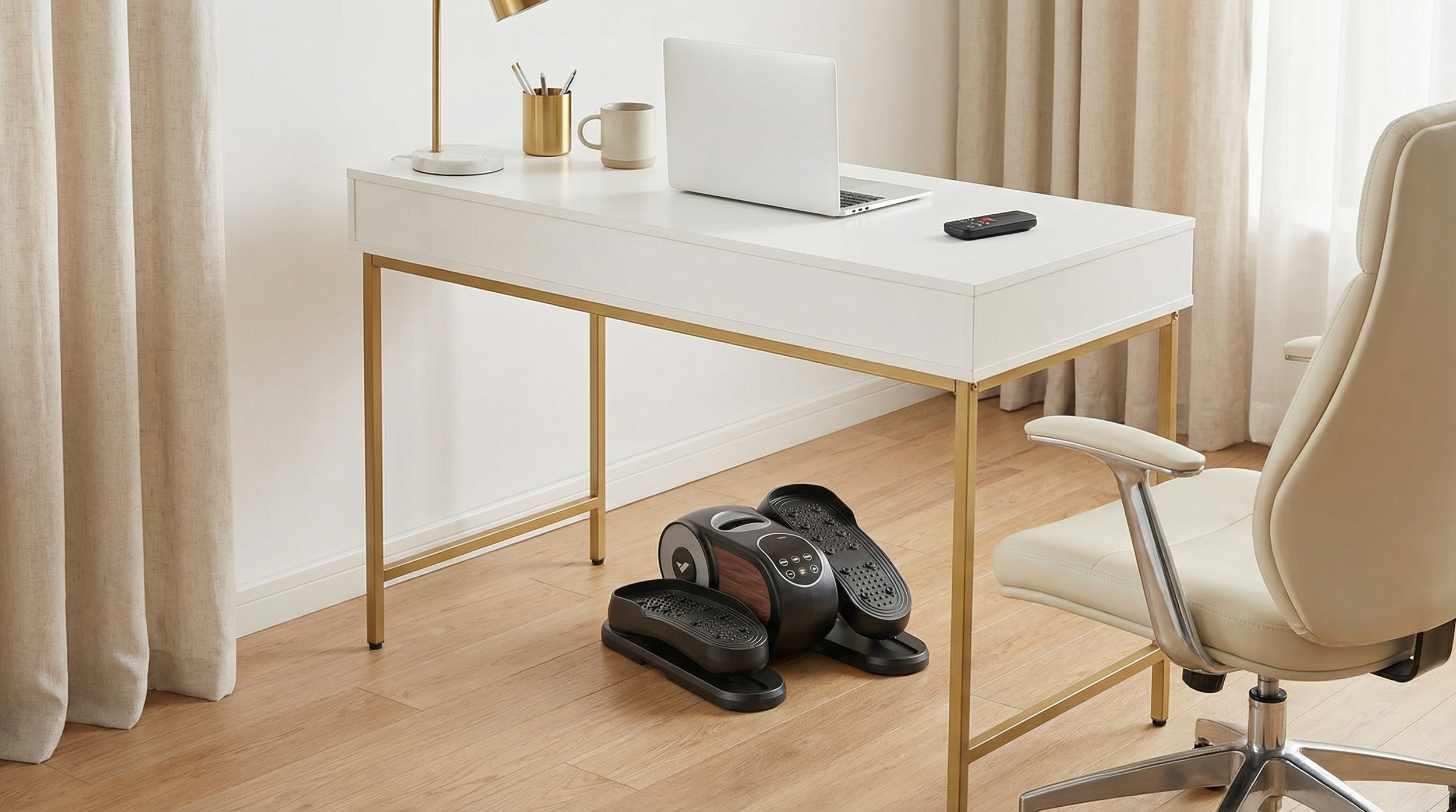
Recumbent Bike: This isn't about cardio. It's about pedaling at a pace slow enough to read or watch, while keeping your legs moving. I do emails, review documents, and even take low-stakes calls while pedaling. No one knows. My brain and body know – later in the day when the sun goes down.
Can be purchased here.

Walking Pad: Tuck it under your standing desk. Walk at 1-2 mph while you clear your inbox or watch free YouTube videos on AI. You should be learning AI anyway—might as well move while you do it. You're not training for anything. You're preventing the 3pm brain fog that makes you reread the same email four times as well as learning something you need to stay current on.
Can be purchased here.

Standing Desk: The baseline. If you're still sitting all day, this is your first move. Alternate sitting and standing. Your body will tell you when to switch. Listen to it. If your employer doesn’ thave one, ask for it, do something for yourself. When I am visiting coaching clients or in airports, I will sometimes just use the kitchen counter during off hours, as it’s the right height. It doesn’t have to be all day; it just needs to be for part of it.

Hand Weights While Reading (or Watching): Keep a pair of 5-10 lb weights next to wherever you read or learn. Industry articles, board materials, that AI tutorial you've been putting off—light curls while you take it in. Your brain has to work slightly harder to do two things at once. That's the point.

Stretch Bands: Shoulder stretches between calls. Upper back work while you think through a problem. Costs almost nothing, takes up no space, and your neck will thank you by February. I always take these with me when I travel as well, to use in my hotel room to always have a workout option.


Signos --
The Real Point
None of this is about fitness. It's about keeping your brain sharp when winter wants to slow you down.
These are small moves. Small changes. But they protect your most valuable asset as an executive: your ability to think clearly.
Pick one thing from this list. Use it for a week during work you'd be doing anyway—or learning you should be doing anyway. Notice what happens to your energy at 4pm.
Then add another.
You don't need a new workout routine. You need small moves that keep your brain sharp while you work.
Start today. It's already dark outside.
What small moves keep you sharp during winter? Reply and tell me what's working for you.
References & Further Reading
Hillman, C. H., Erickson, K. I., & Kramer, A. F. (2008). Be smart, exercise your heart: Exercise effects on brain and cognition. Nature Reviews Neuroscience.
https://www.nature.com/articles/nrn2298Pontifex, M. B., McGowan, A. L., Chandler, M. C., et al. (2019). A primer on the effects of physical activity on the brain. Trends in Cognitive Sciences.
https://www.sciencedirect.com/science/article/pii/S1364661319301034Chang, Y. K., Labban, J. D., Gapin, J. I., & Etnier, J. L. (2012). The effects of acute exercise on cognitive performance. British Journal of Sports Medicine.
https://bjsm.bmj.com/content/46/8/521Elfering, A., Grebner, S., & Ebener, C. (2017). Workflow interruptions, cycling workstations, and alertness. Applied Ergonomics.
https://www.sciencedirect.com/science/article/pii/S0003687016300845Levine, J. A., & Miller, J. M. (2007). The energy expenditure of using a treadmill desk. British Medical Journal.
https://www.bmj.com/content/335/7624/105Tudor-Locke, C., Schuna, J. M., Frensham, L. J., & Proenca, M. (2014). Changing the way we work: Walking workstations. Journal of Physical Activity and Health.
https://journals.humankinetics.com/view/journals/jpah/11/1/article-p99.xmlStraker, L., Levine, J., & Campbell, A. (2009). The effects of walking and cycling computer workstations on performance. Ergonomics.
https://www.tandfonline.com/doi/abs/10.1080/00140130802480769Diamond, A. (2013). Executive functions. Annual Review of Psychology.
https://www.annualreviews.org/doi/10.1146/annurev-psych-113011-143750Oppezzo, M., & Schwartz, D. L. (2014). Give your ideas some legs: The positive effect of walking on creative thinking. Journal of Experimental Psychology.
https://www.apa.org/pubs/journals/releases/xlm-a0036577.pdfPatel, M. S., Asch, D. A., & Volpp, K. G. (2015). Wearable devices as facilitators of behavior change. Journal of Medical Internet Research.
https://www.jmir.org/2015/2/e43/
Research cited from peer-reviewed journals to support general cognitive and productivity benefits of low-intensity movement during the workday.
